

OCTOBER READ / INTERVIEW WITH THE VAMPIRE
the book club is back and spookier than ever 🩸

Welcome back to the book club! This month we will be reading Interview with the Vampire by Anne Rice. IWTV is the first of her series The Vampire Chronicles, but also reads as a proper standalone (the second book in the series was published almost 10 years later). For October, I really wanted to pick something spooky, and Danika actually mentioned reading TVC, which put the idea in my head (thank you Danika!). (Also, too many people keep recommending the TV show to me1, so maybe it’s time to go full throttle with this franchise…)
Interview with the Vampire follows the life events of Louis de Pointe du Lac, a wealthy man living in New Orleans in the 1700s. Following the death of his younger brother, Louis becomes overtaken by grief. He soon meets the vampire Lestat who turns him into… a vampire. Throughout the course of the book, Louis grapples with the morality of vampirism and fights to hold onto traces of his humanity. Louis and Lestat soon begin living together (and yes, it IS kinda gay — gayer than the movie) and tensions rise as their life philosophies clash. This becomes all the more complicated when Lestat brings home a little girl with the intention of turning her as well.
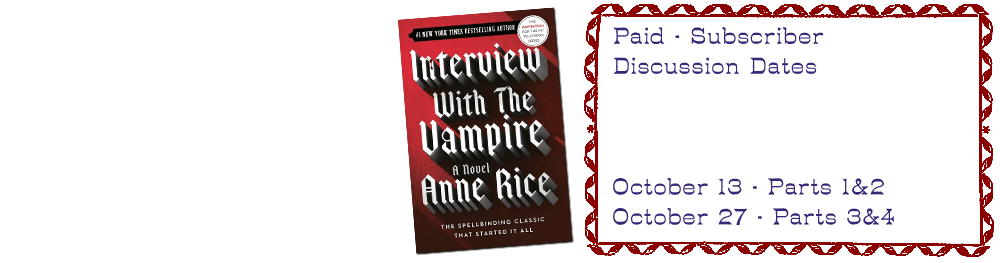

From the cover design, Interview with the Vampire looks like it could be just a trashy, supermarket read. And for some critics, the vampire content itself was enough to smear it as simply “cheap eroticism.” Trust me, I’m not one to turn away from cheap eroticism, but out of respect for literature, I have to push back on this (at least regarding IWTV — I haven’t read other books in the series).
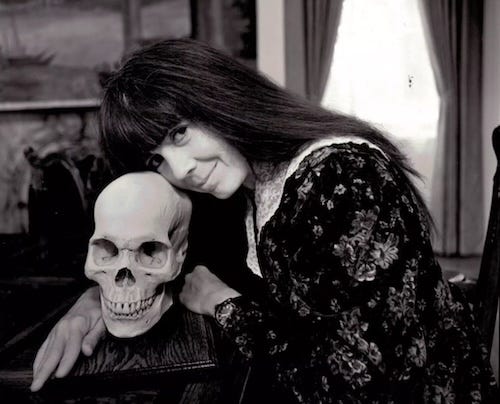
Anne Rice is a masterclass storyteller and there’s never a dull moment in IWTV. And yet, I believe at its core, this book is less about the interpersonal dramas of the vampires themselves and more about what they represent. Vampires are a metaphor to understand the human condition, and it makes complete sense to me that Rice actually wrote this first book in the aftermath of her daughter’s passing, as a way to understand what grief and life is about.
Rice explained in an interview, “I didn’t know it at the time but it was all about my daughter, the loss of her and the need to go on living when faith is shattered.”
Of course, Rice manages to ‘humanize’ these creatures as much as possible — and I quickly became emotionally attached to our protagonist, Louis, and all the relationships he fostered with other characters — but ultimately, vampires are a vehicle bringing to light nuanced ideas on morality, on materialism, on sexuality, etc. After all, it’s us humans who have conceived the vampires; they are products of us and therefore what they understand is what we understand.
Rice literally goes off in a 1995 Rolling Stone interview, addressing the critical dismissals of her books, and she also takes jabs at the state of literary fiction while she’s at it. Crazy that she said this in the 90s, because I don’t feel much has changed:
I think that there’s a real arrogance to the pedestrian realism of the 20th Century novel. Not only are books about ordinary people and ordinary lives and ordinary events and little bitty epiphanies, not only are they not worth reading most of the time, they’re simply garbage. I think our literature is at a low ebb right now, and there’s a lot of reasons we came to this point where we turned away from the incredible power of Nathaniel Hawthorne or Herman Melville or Edgar Allen Poe, and have chosen instead to write a diluted version of Henry James over and over again.
The reasons are, I think, more economic than the elite would like to face. It’s an outgrowth of industrialization, really. It’s the literature of quiet desperation or contentment — a literature that tells you that to try to attempt anything great in your life is unrealistic to the point of being irresponsible and dangerous. It tells you that any novel of substance is going to be about a normal couple in Connecticut or Berkeley, and their quarrel over the custody of the children, and how they both work it out, each in her or his own way.
The truth is, that is not the only story we have to tell. That is not even what our world is about. Our world is in fact filled with abnormal people and outrageous people and cataclysmic events and extremely romantic stories and acts of incredible heroism, and yet for some reason the upper middle class literary writers have decided that that’s not worthy subject matter for their books. And they’re dogmatic and nasty about it. The writers I have known who were novelists who wrote what they considered to be “better” fiction are incredibly smug. The sense of superiority they have to a person like me is limitless.
All’s to say I’m very excited to discuss the myriad of ideas that Rice brings forth in her work. I know this will be a fun month 🧛.
Of course, I would also be remiss to not include Rice’s fanfiction controversy, which made her separately famous among certain internet circles. In short: in 1995, Rice said she didn’t approve of any fanfiction written about her characters.
She said, “I’m very possessive of my characters. I think it would hurt me terribly to read anything with some of my characters. I hope you’ll be inspired to write your own stories with your own characters.”
Ok… fine. But by 2000, she was threatening fansites with legal action for disregarding her wishes, including the once very popular fanfic hosting site, Fanfiction.net. To this day there’s still no Interview with the Vampire/Vampire Chronicles category on the site.
Nice to see that AO3 hasn’t folded. Truly the people’s princess.

It’s all a bit ironic considering the expansions of her universe, specifically the series adaptation, not only strayed incredibly from the original source material but (maybe in doing so) are major reasons for the continued success of her books and legacy today. After all, Interview with the Vampire (the TV show) has more than double the fanfiction:


Are there gradations of good and evil, as Armand suggests? How would you grade the characters in IWTV?
Do you think it’s possible for vampires to feel emotion/love? If not, why? If so, why do you think Louis is so reluctant to accept this?
Most vampires (including Lestat and Claudia) are depicted as materialistic, yet Louis rejects these values and instead, demonstrates a deeper fondness for art. What drives vampires to crave opulence and what separates Louis from these vampires?
Anne Rice has said that when she wrote IWTV, “There was no God.” What role does faith (or lack thereof) play in this novel?
Why do you think it’s difficult for humans in the story to understand the plight of vampires? Almost all of them who are shown crave immortality. If given the choice to become one yourself, would you?
When I asked on IG what fandom I should join haha:
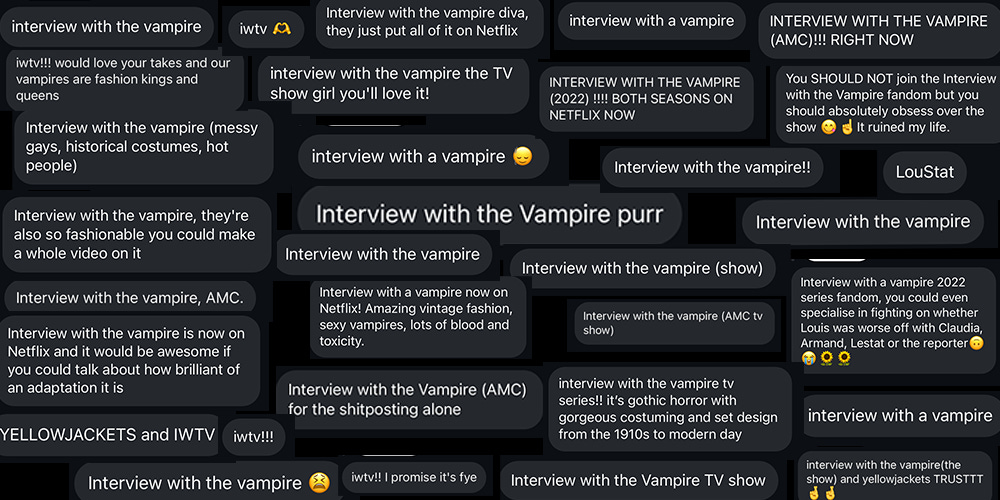
The tv show is so freaking good too!!
So excited! My uncle is teaching this book (for like the 20th time) in his literature class at Brooklyn College so we’re rewatching the series- I can say it is in fact English Lit Professor approved, as well as being waaaaaaay more fun than the original movie.